

Taekwondo Belts: Ranking System And Color Meanings Explained – From White To Black Belt, Gup Ranks, And ITF Traditional Taekwondo


By Way of Martial Arts
In this article, we will delve into Taekwondo’s belt system’s intricacies and reveal much about the martial art and those who practice it. Colors have important meanings, with the red belt denoting ultimate achievement.
The journey of a Taekwondo practitioner is marked by progress from one colored belt to another over many years of dedication and hard work. Striving for their mastery of the art, practitioners slowly accumulate skills and knowledge until they reach their highest potential – holding a red belt.
Earning this honor ranks as one of the most valuable accomplishments that one can attain in Taekwondo, as it demonstrates total comprehension and skill in both physical technique and key philosophical principles such as humility, respect, generosity, integrity, patience, and discipline.
These ideals are integral to this iconic martial art; they are integrated into its fundamentals. Conversely, achieving a red belt requires great skill and admittance to a high-level understanding of these principles, which underpin Taekwondo’s success.

ITF Taekwondo ranking system has 10 ranks, ranging from 10th kyu (white belt) to 1st dan (black belt). WTF Taekwondo has 11 ranks where belt colors are: white (11th kyu), yellow, orange, green, purple, blue, blue and black, brown, brown and black, red, red and black, and black (1st dan).
Each of the belts represents a degree of knowledge, but – as we will soon learn – the two chief Taekwondo organizations, WT and ITF, have different standards regarding belts.
Contents show
The Origins of Belts in Martial Arts and the History of Taekwondo Belts
Oriental martial arts have been practiced in the Far East for centuries, but the belt system is a relatively new phenomenon, just a little over a century old. Before belts were introduced, martial artists handed out certificates (or diplomas) to students who had reached a certain level of knowledge and ability.
A Guide to the Various Taekwondo Belt Rankings and the Requirements for Each
The Evolution of Taekwondo Belts: How the TKD Belt System Has Changed Over Time
The Importance of Properly Earning and Wearing Taekwondo Belts in the TKD Community
Taekwondo is a martial art that has been gaining popularity for many years, and for good reason. One of the key aspects that sets it apart from other martial arts is its belt system. The taekwondo belts are an integral part of the art and serve as a visual representation of the knowledge and skills that each practitioner holds. The taekwondo belts come in a variety of colors, each representing a different level of proficiency. The journey from white belt to black belt is a long and challenging one, but it is also incredibly rewarding. The taekwondo belts are not only a symbol of the knowledge and skills that a practitioner holds, but they also serve as a marker of progress and motivation. As a practitioner advances through the ranks, they will be required to pass various tests and demonstrate their proficiency in various techniques and forms. The taekwondo belts are not just handed out, they are earned through hard work and dedication. Each belt represents a new level of knowledge and skill that must be attained before moving on to the next. The ultimate goal for most practitioners is to reach the coveted red belt. The red belt is the highest ranking belt and is held by only a select few. It is a symbol of mastery and represents years of dedication and hard work. Overall, the taekwondo belts serve as a standard for the art and are a key aspect of the discipline. Understanding the belt system and working towards the next rank is a great way to stay motivated and track your progress as you learn the art of Taekwondo. Whether you’re a beginner or an experienced martial artist, Taekwondo belts are an essential part of the journey and provide a tangible way to measure progress and success.
Kano’s Belt System and Its Impact on Taekwondo Belts and Gup Ranks
But, at the turn of the 20th century, a man called Jigorō Kanō, best known as the founder of judo, decided to introduce colored belts in his art.
This was not a completely original idea, as he was inspired by a similar system present in the Japanese board game of go (similar to chess), but it was a revolution of belt colors in the world of martial arts.
The essential idea behind the belt system was to enable students to advance more rapidly but also to enable fighters to quickly identify the level of knowledge their opponent has, thus leading to a more leveled field in potential combat.
Kanō’s original colors were blue, white, brown, and black, but as the years passed, the system became more sophisticated and included a larger palette of colors.
The colored belts in Taekwondo are usually defined as “junior belts” and they represent a student of the art.
The black belts are given to masters or instructors, people who have mastered the art and are qualified to teach it to others. They are also called “senior belts”.
The Taekwondo Belt Order and System – Understanding Dan Levels and Gup Ranks
As stated, the belts are divided into two larger groups – “junior” and “senior.” The former includes colored belts, while the latter encompasses a variety of degrees of Taekwondo black belts. The starting color is always white, and the final level is a 9th-degree black belt.
Gup vs Dan: Differences in Rank and Progress in Taekwondo
The “junior” levels are called geup (급) and there are, generally speaking, around 10 of them; the actual number varies between 8 and 12, depending on the style and the governing organization.
Each level doesn’t always mean a specific color; the system is designed to include different colored stripes representing a higher degree of the same color.
The geup system starts with the highest number in the system and continues until the 1stgeup, the last colored rank, before attaining a black belt. The 1st dan is a basic black belt.
The black belts are divided into ranks that are called dan (단) or, in English, degrees. The degrees start with the lowest number (1stdan or first-degree black belt) and reach the final, 9thdan (ninth-degree black belt), associated with the grandmaster title.
The WTF Taekwondo belt order and ITF Taekwondo belt order have a title-based system associated with black belt degrees. Instructors holding degrees 1-3 are called assistant instructors and cannot issue black belts themselves; degrees 4-6 are associated with the title of master instructor (just instructors via ITF).
The last ranks show the biggest difference between WTF and ITF – WTF associates the title of grandmaster status with all the ranks from 7 to 9, while ITF does so only for the final, 9th rank, giving the holders of ranks 7 and 8 the titles of masters.
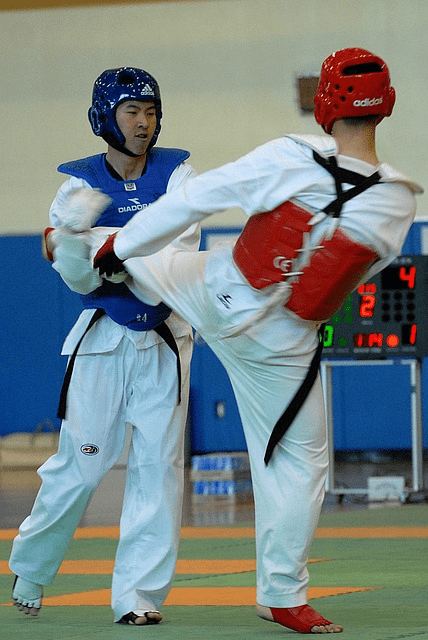
Age Limit and Time Requirements for Achieving Higher Ranks in Taekwondo, such as Black Belt
The black belt is awarded from 15 onwards (the age limit has changed throughout the years and is currently set at 15).
That, of course, doesn’t mean that younger children cannot pass dan exams, but they are awarded a special poom rank, which is a “junior” black belt (usually red and black, or red with black stripe).
The poom rank automatically converts to a regular dan when the trainee reaches the proscribed age of 15 years.

Forms, Technical Elements, and Sparring for Promotion in Taekwondo
Promotion in Taekwondo is achieving a higher rank within the discipline. As a student of Taekwondo, the journey begins with the mandatory white belt. Through hard work and dedication, students progress through the ranks, starting with the yellow belt and moving up through the different colored belts. The process of promotion becomes increasingly challenging as the ranks become higher. Still, it is a testament to the technical and tactical skills a trainee has learned throughout their training journey.
Forms, also known as promises or hyeong, are one of the key elements students must master to be promoted. These pre-arranged patterns of movements demonstrate a student’s understanding of Taekwondo’s basic techniques and principles. Technical elements, such as kicks, strikes, and blocks, are important aspects of a student’s training and are closely evaluated during the promotion process.
Sparring is another important element of Taekwondo training and is often used to evaluate a student’s ability to apply their technical and tactical skills in a more realistic setting. Through the combination of forms, technical elements, and sparring, Taekwondo students can ultimately demonstrate their proficiency and progress through the ranks to achieve the coveted black belt.
How Much Time Do I Need to Progress in Taekwondo Belt Rankings? And How to be prepared for Sparring
Lower ranks usually require not more than a demonstration of different attacks present in Taekwondo and one specific form, predetermined as a skill test for each degree. Forms demonstrate the offensive and defensive skills of students’ Taekwondo training while also demonstrating technical skills. The number of forms depends on the style used (p.e. WTF has 8, while ITF has 9), and the forms change regularly, but only to a smaller degree. A successful demonstration of all these necessary skills allows the trainee to obtain a promotion.
To be prepared for sparring, it is important to focus on physical conditioning, practicing proper technique, and developing good reflexes. This can be achieved through regular training, drilling, and sparring with partners of varying skill levels. Additionally, it is important to have the proper gear, such as a mouthguard, headgear, and gloves. Higher ranks usually add more complex techniques, including sparring, simulated sparring, self-defense, breaking skills, and even a written test on the basics of Taekwondo. Although the organizations have a system of guidelines, each federation can have its variations of minimal standards.
“Junior” promotions are usually held within the school or local community, while black belts (and poom ranks) are usually awarded by the national federation and are internationally recognized. The time necessary for promotion depends on the school, the national federation, and the rank in question. Lower ranks are usually attained after a few months (1-3) in rapid progression, while higher ranks usually require a certain period to pass before trying out for promotion. There are some cases where promotion from rank one to rank two is given automatically, while others require a regular promotion. The period between promotions can range from one month to more than a year. Each school and/or national federation determine those periods.
WTF Belt at ITF Competition: Understanding the Differences in Taekwondo Belts
An interesting question is whether ranks are interchangeable and recognized by opposing federations, i.e., does WTF recognize ITF ranks and vice versa?
The answer is yes – ITF degree holders can participate in WTF events and vice versa – but due to political tensions and quarrels, the situation was not always simple and easy for the competitors.

Taekwondo Belt Colors Ranked: From White to Black Belt and ITF vs WTF Belts, and the Significance of Color
We have already explained that black belts have nine degrees so that we won’t dwell on that question anymore.
That system is simple enough. But, the “junior” degrees, which use different colors, are interesting as they show how the initial belt system, developed at the start of the 20th century, was incorporated into the sport of Taekwondo.
ITF Vs WTF Belts
Since WTF and ITF have somewhat different standards for“junior” belts, we will briefly analyze both systems:
- The ITF system
The ITF system uses what we have already called a geup. There is a total of 10 geup in the ITF system, and they start from 10 and finish at 1.
The system uses only five colors, with each color having a higher degree variant, represented by a colored stripe added to the main belt; the color of the stripe is always the color of the next degree color (p.e. a second-degree green belt has a blue stripe because blue is the next color in the system).
For example, white with yellow stripe, yellow belt with green stripe… In this case, a green stripe means the higher level of the basic yellow belt. The colors are as follows:
Color Geup Meaning 10th Blankness, lack of knowledge,
Beginning 9th Middle phase between white and yellow 8th A seed planted 7th Middle phase between yellow and green 6th A planted seed starts to grow, and mature 5th Middle phase between green and blue 4th The sky the grown seed tries to reach3rdMiddle phase between blue and red 2nd The color of blood, a warning about the dangers of the skill 1st Middle phase between red and black Black belt (1st dan)
- The WTF system
WTF doesn’t use the geup system per se, but the general idea is similar. WT uses only ranks, and a specific color generally represents each rank; there are some variations of the same color with the higher ranks.
Most WTF schools use the system presented below, but slight variations exist worldwide. WTF has a total of 11 ranks obtainable before the red belt, ergo one more than the ITF systems.
Stripe Example and Understanding the Significance of Belt Stripe in Taekwondo, including Red Stripe for Seniority
In Taekwondo, the belt system indicates a student’s progress and experience within martial arts. One way this is done is through stripes on the belts. A vertical stripe on a belt is used as a symbol of seniority, with the number of stripes indicating the level of progress. For example, a red belt with a black stripe would indicate 1st kyu, while a red belt without a stripe would symbolize 2nd kyu.
The belt is typically divided into two halves, with the upper half red and the lower half black. This represents the 1st-dan level. As the student progresses, they will earn additional stripes on their belt, representing their increased skill and experience.
The use of different colored belts and stripes is a unique aspect of Taekwondo and helps to visualize a student’s journey and progress within the discipline. Understanding the significance of belt colors and stripes is important in Taekwondo training, as it allows students to track their progress and recognize their peers’ achievements. In addition, it helps instructors and other students identify a student’s skill level and experience.
It’s important to note that the belt colors and stripes system may vary slightly depending on the organization or style of Taekwondo. Still, the general concept of using them as a representation of skill and experience is consistent across different organizations. Additionally, it’s crucial to remember that the belt stripe is only one aspect of Taekwondo’s overall progress and ranking system and that many other factors, such as forms, sparring, and testing, are also considered.
Taekwondo Conclusions: Inspiring Readers to Dive Deeper into the Martial Arts and its Belt System
In conclusion, Taekwondo is a dynamic and exciting martial art that holds a standard for physical skill and knowledge. The ranking system, with its different colored belts, including the highly respected red belt, is a significant aspect of the discipline. As you progress through the ranks and learn more about the art over the years, you will be tested on your knowledge and physical skills. With the help of dedicated instructors, you’ll soon discover that Taekwondo is a discipline that can change your life for the better.
If you’re looking for a new challenge and an exciting way to improve your health and fitness, we encourage you to try Taekwondo. Whether you’re a beginner or an experienced martial artist, Taekwondo has something to offer everyone. So, take the first step and find a school near you. With the help of dedicated instructors, you’ll soon discover that Taekwondo is a discipline that can change your life for the better. The tests and standards held in Taekwondo are rigorous but attainable, and reaching the red belt is the ultimate goal for many students after years of dedication and hard work.
Related articles: The history of belts and belt colors in martial arts.



![Martial Arts Clique MartialArtsClique 30 Hottest UFC Female Fighters Pictures Included 30 Hottest UFC Female Fighters [Pictures Included!]](https://martialartsclique.com/ma/wp-content/uploads/2024/01/MartialArtsClique-30-Hottest-UFC-Female-Fighters-Pictures-Included-1024x576.jpg "Martial Arts Clique 30 Hottest UFC Female Fighters [Pictures Included!] 6")


Responses